
Doing Business in the Gulf: The Costly Mistake of Assuming English Is Enough

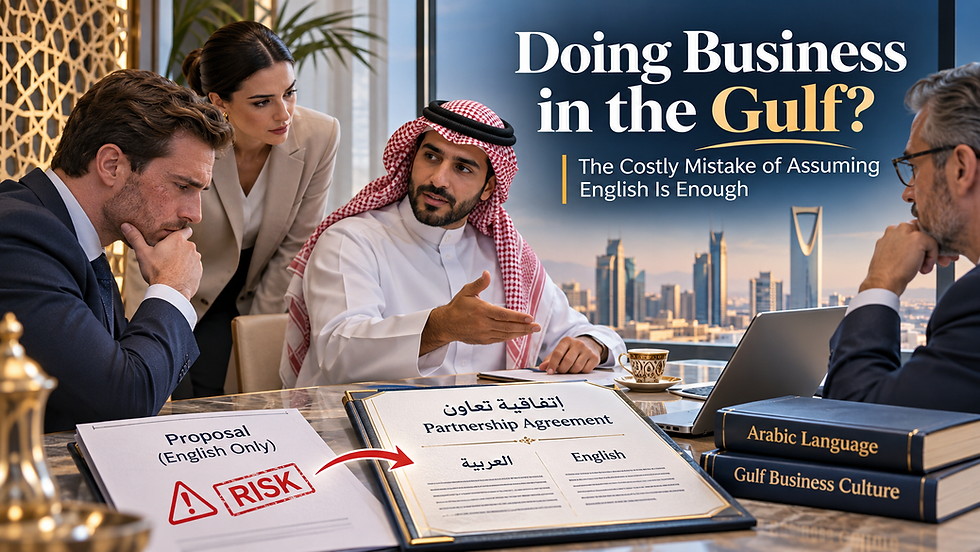
The Arab world, and more specifically, the Gulf region, has played host to an international workforce for decades, resulting in a culturally and linguistically diverse professional environment. As a result, many will tell you that English is the de facto lingua franca in the region, confidently assuring you that English proficiency alone is more than enough to work effectively there. However, this oversimplification couldn't be further from reality.
In fact, this isn't just a harmless overgeneralization. It misconstrues how things actually work in the region, and it's exactly the kind of professional oversight that can lead to costly (and often avoidable) cultural and linguistic misunderstandings. The mistake isn't in recognizing that English is widely used, but in assuming that its widespread use eliminates the need for Arabic-language competence or cultural intelligence.
When Arabic Is a Legal Requirement, Not a Preference
Although English is indeed widely spoken across the Gulf, in several countries, including Saudi Arabia, Qatar, and the UAE, Arabic is legally required for various forms of official correspondence, government documentation, and contractual dealings.
In Saudi Arabia, for example, Council of Ministers Resolution No. 266 requires foreign companies operating in the Kingdom to use Arabic in correspondence with government authorities. Violations can result in fines of up to SAR 10,000 per offense, with penalties doubled for repeated violations and potential restrictions on government dealings.
Similarly, Qatar's Law No. 7 of 2019 requires government authorities and certain other institutions to use Arabic in official activities, including correspondence, contracts, and documentation. In the UAE, Article 39 of Federal Law No. 11 of 2023 requires Arabic in federal procurement contracts and related documents, although English may be used when the relevant federal agency considers it necessary.
Of course, the precise requirements vary between countries, institutions, and transactions, and not every business interaction is subject to the same rules. Nevertheless, businesses that assume English alone is sufficient risk noncompliant submissions, regulatory complications, costly delays, and potentially lost commercial opportunities, sometimes before negotiations even begin.
While companies can rely on translators, bilingual employees, and legal advisers to navigate these requirements, there is a much broader issue that is frequently overlooked, and one that cannot always be resolved simply by translating a document.
Speaking the Same Language Doesn't Mean Sharing the Same Culture
Furthermore, having a common language does not equate to sharing a common culture.
Two professionals may speak perfectly good English, yet have entirely different expectations surrounding hierarchy, professional etiquette, disagreement, negotiations, and decision-making. Consider, for example, how disagreements are handled in professional settings. What might be considered perfectly acceptable, or even encouraged, in one workplace could be interpreted as disrespectful, confrontational, or inappropriate in another, particularly when differences in seniority or authority are involved.
And the consequences aren't always immediately apparent.
A friend of mine once got into a disagreement with the head of a local team and approached the situation much as he would have in a Western workplace. And this wasn't someone who was new to working internationally. He was a senior professional with an accomplished international career, including considerable experience in the region itself.
Afterwards, he was convinced he'd won the argument and that the matter was settled. When he recounted what had happened to me, however, I had a very different interpretation. In fact, I was certain he had lost his job. He just didn't know it yet.
Sure enough, shortly afterwards, his visa was suspended. He contacted his employer, convinced there had been some administrative mistake, only to discover that there was no mistake. He would not be returning. He was completely blindsided.
What struck me most was how differently we had interpreted the same interaction, despite his extensive international experience. He believed he'd successfully resolved a disagreement, whereas I recognized just how serious the situation had become. While I can't speak to every consideration behind his employer's decision, what was clear to me was that he had fundamentally misunderstood the professional implications of the exchange.
And that is precisely the point: international experience, even within the region itself, does not necessarily translate into cultural intelligence.
The Hidden Commercial Costs of Cultural Misunderstanding
Now consider the implications when similar misunderstandings occur during high-stakes negotiations, government meetings, or interactions with key stakeholders.
A professional may have decades of international experience, exceptional technical qualifications, and a proven track record of success, yet still find themselves inadequately prepared to navigate the cultural expectations of a particular business environment. In fact, previous experience can sometimes create a false sense of confidence, particularly when individuals assume that familiarity with one country, organization, or professional setting automatically prepares them for another.
The resulting problems are not always obvious. A negotiation that unexpectedly stalls, a business relationship that deteriorates, or a stakeholder who becomes increasingly unresponsive may be attributed to any number of factors, including commercial disagreements, bureaucratic obstacles, or personality differences. And while these explanations may well be correct, they can sometimes obscure a more fundamental issue: a failure to understand the cultural context in which the interaction took place.
This is particularly relevant in professional environments where hierarchy, trust, interpersonal relationships, and established expectations can strongly influence how business is conducted. A poorly handled disagreement or an unintended breach of professional etiquette may damage a relationship that took months or even years to establish.
For international businesses, such misunderstandings can have consequences extending well beyond the individuals involved, potentially affecting stakeholder confidence, negotiations, project timelines, and long-term commercial relationships.
Why Cultural Intelligence Requires More Than International Experience
It is equally important to recognize that the Gulf is not culturally homogeneous. Saudi Arabia, the UAE, Qatar, Kuwait, Bahrain, and Oman each have distinct social, linguistic, and professional environments, with considerable variation between industries, institutions, organizations, and individuals.
A senior executive attending negotiations in Riyadh, for example, will not necessarily encounter the same professional expectations as a project manager working with local teams in Abu Dhabi. Nor should international professionals assume that cultural practices encountered in one Gulf country will automatically apply to another. Yet the tendency to approach the Gulf, or indeed the wider Arab world, as though it represents a single, uniform cultural environment remains a common misconception.
Effective cultural intelligence therefore requires something considerably more sophisticated than memorizing a list of dos and don'ts. It involves understanding how cultural expectations influence communication, relationships, hierarchy, and decision-making, while developing the ability to recognize and respond appropriately to those expectations in different professional contexts.
The same principle applies to Arabic-language training. Not every international employee needs to become fluent in Arabic, and their linguistic requirements will depend largely on their role, responsibilities, and the people with whom they interact. For some, practical conversational Arabic may be invaluable for developing stronger relationships with local colleagues and stakeholders. Others may benefit more from role-specific Business Arabic or focused cultural-awareness training.
Even the Arabic language itself requires a more nuanced understanding. The Modern Standard Arabic used in formal documentation differs from the regional Arabic dialects commonly used in everyday conversations and informal workplace interactions. An organization may therefore meet its formal documentation requirements while its international personnel remain unable to participate fully in the conversations and relationships that shape much of professional life.
The objective should not be to turn every international employee into a linguist or cultural expert, but to ensure that they are adequately prepared for the environment in which they are expected to operate.
English Proficiency Alone Is Not Business Readiness
English undoubtedly plays an important role in Gulf business environments and will continue to serve as a common working language for many international professionals. But the ability to conduct a meeting in English is not the same as understanding the cultural, linguistic, and professional expectations surrounding that meeting.
For companies operating in, entering, or expanding across the Gulf, these distinctions are not simply matters of cultural sensitivity or professional etiquette. They can have a direct bearing on how effectively employees communicate, manage relationships, navigate disagreements, and represent their organizations.
Arabic-language competence and cultural intelligence should therefore be considered important components of international business readiness, rather than optional additions to an employee's professional development.
Because ultimately, being qualified to do the job doesn't mean being prepared to do it in the Gulf.